
Private Virtual Mentor
We will use automation and AI systems to guide each student through a personalised journey of learning by doing. Pre-designed challenges will be presented to each student throughout the course in a bespoke environment where the student gets to solve those challenges while receiving specific feedback from a virtual mentor.


Forging real skills from day one
It is our goal to prepare you for a successful future career. You can’t learn in a vacuum, so our courses focus on integrating industry-relevant skills to help you become an agile, adaptable specialist.
Industry recognised
A number of advanced modules are offered as stand-alone professional development short courses, which all contribute to the module`s industrial reputation.
Industry experience
Students will be required to complete practical work, projects, and dissertations based on industrial applications and current research supervised by subject experts at the forefront of emerging and established fields.
Flexible
By choosing advanced modules according to your career goals, you can customize the courses to meet your needs.
Teaching team
Our teaching team has academic and industrial experience and works closely with businesses. In order to ensure you benefit from the latest knowledge and techniques affecting the industry, the knowledge gained working with our clients is continually incorporated into the teaching programme. Additionally, there will be guest lecturers from the industry who will relate theory to current best practices.
Training for employability skills
An advisory scheme for careers
A pioneering Careers Advisory Scheme has been launched at the college. We help our students to grow in confidence and find their future career paths. They will talk to you about how to make informed career choices, manage your career development, access opportunities to develop the skills employers demand, and reach your career goals. They also organize skills development workshops and employer presentations where you can network directly with graduate recruiters.
They are also available to help if you:
Having trouble making decisions and figuring out what to plan.
Need help with completing application forms or writing a CV?
Looking for a job but not sure where or how to start
Would like to find out more about postgraduate study or receive advice
You need to practice your interview techniques
Alumni up to two years after graduating can also book 1:1 appointments
We offer online career consultations via advisory@surreycollege.org

Learning model
Methods of teaching include:
Lectures:
10% of your studying time will be lectures (either live or pre-recorded). lectures are used in programmes to give an overview of a particular field of study. They aim to provide the stimulus and the starting point for deeper exploration of the subject during your study
Seminars:
Give you the chance to explore a specific aspect of your subject in depth and to discuss and exchange ideas with fellow students. They typically require preparatory study.
Presentations:
In the presentation, you design and produce computer visuals (slides) to convey the results of a systematic study of a significant Computer Science problem. A presentation can be presented by computer or by using traditional means, such as overheads and slides.
Tutorials:
During tutorials, students in a particular course discuss topics in groups. Each group is led by a tutor.
Individual projects:
You can advance your knowledge in a particular area of interest through a research project. We base all our projects on real research,
Group projects: (Cooperative learning)
The group project is an important component of this MSc course, in which each group develops a solution to a real-world problem. In general, the project lasts six weeks between February and March. Assigning roles to each person is the responsibility of each group member. You will have the opportunity to see how a software development team is structured and how different roles contribute to the final product. This will be when you participate in the group project. It gives you a chance to get a better understanding of what is expected of you once you are employed and how development teams are organised.
Workshops:
Workshops are designed to facilitate discussions, brainstorm ideas, identify problems, make decisions and develop solutions among students.
Practical laboratory sessions:
When students spend more time in the laboratory, they will be able to develop better skills. Students who implement their projects during their training on real-world problems will gain experience early in the sense of the problems they will face in the workplace and be more inclined to obtain relevant work experience. That`s why our college educates students using the computer lab.
Modules:
The modules we offer reflect the needs of business and industry . Changes may also be designed to improve the student learning experience or to respond to feedback from students, external examiners, accreditation bodies and industrial advisory panels.
In addition, you will be expected to undertake significant self-directed study each week, depending on the demands of individual modules.
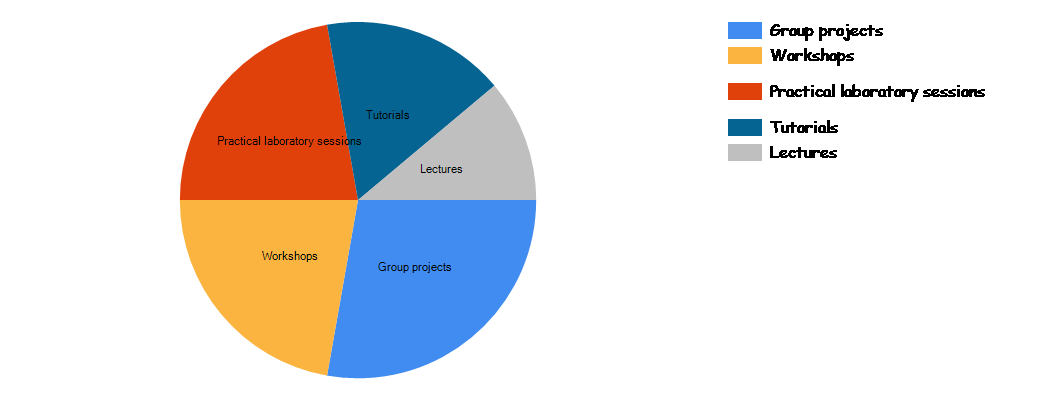
Class rooms
We use the 70-20-10 model. It holds that individuals obtain 70% of their knowledge from job-related experiences, 20% from interactions with others, and 10% from formal educational events.
Approximately 10% of your studying time will be devoted to lectures (either live or pre-recorded). A majority of the classroom time will be dedicated to group activities. During these activities, the lecturer will guide the students through a practical application of the theoretical lectures they have watched. It is interactive, with the active participation of the whole class, moderated by the lecturer.
The benefits of Group-Based Interactive Learning are:
Increase motivation and collaboration among students, freedom of choice, student-teacher dynamic, adaptability, sharpen critical skills, encourage a different mindset, an enjoyable classroom environment, and Deep learning in order to improve goals and outcomes.
FAQs:
Please see OUR APPROACH page
NO
Start by talking to one of your lecturers.
Then look at this advice on changing or leaving your course.
Finally arrange to speak to a Careers Consultant about your next step.
| Title: | Note: |
| Qualifications or Experience | A minimum of an upper second-class UK Bachelor`s degree (or international qualification of an equivalent standard) in computer science, computing, or software engineering. Relevant work experience may also be considered. |
| English language requirements |
In order to complete your programme successfully, it is important to have a good command of English and be able to apply this in an academic environment. Unless you are from one of a recognised majority of English-speaking countries, you should provide certificated proof of English language competence before commencing your studies. IELTS Academic test with an overall score of 6.5, with no element below 5.5, or meet the scores listed on the alternative online tests. |
| Essential IT (online course) |
Sometimes, for example, if you do not already have a qualification in IT, we may make a conditional offer to you, subject to successfully completing our online course for IT Foundation and Programming. This will be provided free of charge to qualifying applicants. Your success in this course will demonstrate your commitment and ability to learn advanced digital skills, leading to an unconditional offer. |